Note (October 2026): An earlier version said Shopify is not available in multiple languages. That is wrong; every plan includes storefront translation, and the article has been updated with current plans and fees.
Shopify pros and cons in short: Shopify is a hosted e-commerce platform that is easy to set up without coding, includes hosting, an SSL certificate, checkout and payments, and scales from solo sellers to large brands. The main cons are recurring costs (plan, apps, themes and payment fees), third-party transaction fees if you skip Shopify Payments, and limited checkout customization below Shopify Plus.
Key Takeaways
- Shopify Inc. was founded in 2006 and is headquartered in Ottawa, Canada; it reports over five million customers.
- As of October 2026 there are four main plans: Basic, Grow, Advanced and Plus.
- Using a third-party payment provider costs an extra 2% (Basic) down to 0.2% (Plus) per sale.
- Shopify does support multiple languages; the free Translate & Adapt app auto-translates up to two.
- Full checkout customization is reserved for Shopify Plus.
Technology has been growing by leaps and bounds; it is very dynamic as well which has opened spaces for entrepreneurial instinct of every person. Selling online can reach far more customers than a single physical shop, which is a major reason hosted e-commerce platforms became popular.
Shopify, a Canadian company headquartered in Ottawa and founded in 2006, is one of the best-known of these platforms. It bundles the storefront, checkout, payments and order management into one subscription, so a merchant does not have to assemble those pieces separately.

Shopify does not require coding skills: a store can be built from a ready-made theme in the browser. For example, someone starting a sports-goods store can begin with one of the many ready-made sports shopify themes easily.
Shopify lowers the technical barrier for anyone starting an online store, although the monthly plan, apps and payment fees add up (see the pricing table below). A merchant does not need to hire a developer for routine updates such as adding products, changing prices or editing pages, because these are done from the Shopify admin.
Shopify takes care of hosting and maintenance because it is a one-stop e-commerce platform that offers free and paid themes which can be customized; checkout customization is limited on the Basic, Grow and Advanced plans and full only on Shopify Plus, according to Shopify’s pricing page (October 2026), as described in this article from AfterSell.
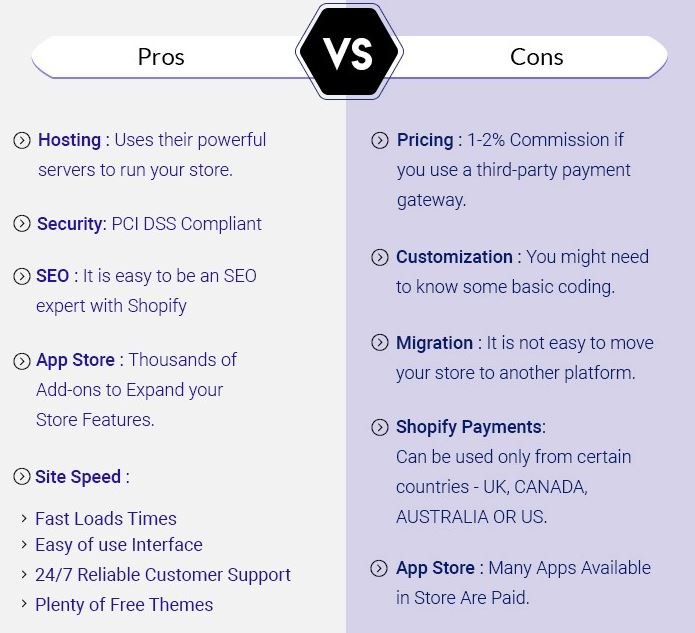
Shopify is easy to start with, but like every platform it has trade-offs. The main Pros & Cons that are discussed below:
Pros of using Shopify
Ease of use
Shopify is very easy and simple to use even for a layman who does not have much knowledge about coding or tech skills. It has various themes available to choose from which you can get keeping your requirements & needs in mind. Products, inventory, orders, payments, discounts, email marketing and analytics are managed from one dashboard.
Secure space at great speed
Shopify has its own payment processor, Shopify Payments (launched in August 2013 in partnership with Stripe), and also works with third-party payment providers, so customers can pay with major cards at checkout. Every plan includes unlimited web hosting and a free SSL certificate, according to Shopify’s pricing page (October 2026), so merchants do not manage servers, speed or security certificates themselves.
Multiple theme
The Shopify Theme Store lets merchants filter themes by industry (for example sports, food and drink, clothing or beauty), by price (free or paid) and by catalog size. It helps customer to decide easily as different sectors have different themes and user can decide among those themes what exactly they want and also can customize the themes as per their requirement.
For example if you want to start a food delivery business, you can filter the Theme Store by the food and drink industry and choose from that shortlist. It makes it easy to navigate through the webpage and you can make the best choices for you.
Flexibility
A Shopify store can be changed at any time: merchants edit content in the theme editor, switch themes, and add features from the Shopify App Store, which opened in June 2009. It helps you to add feature to your store easily without much of the hassle.
Happiness of owning your own entrepreneurial venture
Shopify lets makers sell handicrafts, food products, art and similar goods online without building a website from scratch.
The same store can also sell in person through Shopify POS and on social and marketplace channels, all included in the plans listed on Shopify’s pricing page (October 2026). It is very useful for small business entrepreneurs who wish to mark their presence in the online spaces.
Cons of using Shopify
Cost matters
The monthly plan is only the starting cost: paid themes, paid apps and payment processing fees can raise the total well above the base plan price.
Merchants who use a third-party payment provider instead of Shopify Payments also pay Shopify a third-party transaction fee of 2% on Basic, 1% on Grow, 0.6% on Advanced and 0.2% on Plus, according to Shopify’s pricing page (October 2026).
Multiple Languages Need Setup
The original version of this article said Shopify is not available in multiple languages; that is not correct as of October 2026, because Shopify’s pricing page lists “Translate your storefront” and localized selling with Shopify Markets on every plan. The real limitation is effort and cost: Shopify’s free Translate & Adapt app auto-translates up to two languages, and further languages must be translated manually or with another app. Shopify’s business is still concentrated in the United States: according to its 2024 annual report, 57% of the US$292.3 billion in transactions it processed in 2024 was in the US.
Shopify has its own set of pros and cons but it has certainly set a standard in the market on being a single solution to business who wants to leave an impact on the virtual world also. It allows ease of use and customize options are also available readily.
Shopify multiple themes cater customers of different domains and that too with variety of options available to choose from. Its drawbacks are mainly cost and add-on complexity; for most small and mid-sized sellers they do not outweigh the advantages.
What Is Shopify?
Shopify is a cloud e-commerce platform that lets businesses build an online store, take payments and manage orders from one dashboard. Shopify Inc. was founded in 2006 by Tobias Lütke, Daniel Weinand and Scott Lake after they ran Snowdevil, an online snowboarding equipment store, and the platform launched as Shopify in June 2006.
Key milestones, according to Wikipedia and the company’s filings: the Shopify App Store and API platform opened in June 2009, Shopify Payments launched in August 2013 with Stripe, and the company went public on May 21, 2015. Shopify reported revenue of US$11.6 billion for 2025 in its annual report filed with the US Securities and Exchange Commission.
Shopify themes are built with Liquid, an open-source template language Shopify created, which is why developers can customize a theme far beyond the visual editor when a store needs it.
How Much Does Shopify Cost?
Shopify prices differ by country and by billing period, so always check the pricing page shown for your location. The table below uses the Canadian prices Shopify listed in October 2026; there are no setup fees on any plan, according to Shopify.
| Plan | Price billed yearly (CAD/month) | Price billed monthly (CAD/month) | Third-party transaction fee | Additional staff accounts |
|---|---|---|---|---|
| Basic | $37 | $49 | 2% | None listed |
| Grow | $99 | $132 | 1% | Up to 5 |
| Advanced | $389 | $517 | 0.6% | Up to 15 |
| Plus | From $3,400 | From $3,400 | 0.2% | Unlimited |
Online card rates with Shopify Payments in Canada start at 2.8% + 30¢ on Basic, 2.6% + 30¢ on Grow, 2.4% + 30¢ on Advanced and 2.15% + 30¢ on Plus, according to the same page. In India, the same page listed Basic at ₹1,499 per month billed yearly.
Shopify Pros and Cons at a Glance
| Pros | Cons |
|---|---|
| No coding needed; stores start from a theme | Recurring monthly cost on top of apps and paid themes |
| Hosting and SSL included on every plan | Extra 0.2% to 2% fee when not using Shopify Payments |
| Built-in checkout, payments, POS and marketing tools | Full checkout customization only on Shopify Plus |
| Integrations with thousands of apps | Free auto-translation limited to two languages |
| Scales from solo sellers to enterprise plans | The store runs on Shopify’s hosted platform, not your own server |
Who Should Use Shopify?
Shopify suits sellers who want a working store quickly and prefer paying a monthly fee over managing hosting, security and updates themselves. It fits product businesses of most sizes, including stores that also sell in person.
A self-hosted option such as WooCommerce on WordPress can make more sense for someone who already runs a WordPress site or wants full control of the code and server; the trade-off is more technical work. Our comparison of Shopify vs WooCommerce covers that choice in more detail.
How to Decide if Shopify Is Right for Your Store
- Estimate monthly sales, then compare the plan price plus card or third-party fees at that volume.
- List the apps you will need (reviews, subscriptions, translation, shipping) and add their monthly prices.
- Check whether you need staff accounts; Basic lists no additional staff accounts, Grow allows up to 5.
- Decide whether you will use Shopify Payments; if not, budget the third-party transaction fee.
- Use the free trial to build a test store before paying for a full plan.
For the wider planning, see our guide to the steps to starting an e-commerce business, realistic expectations in how much you can make on Shopify, and the dropshipping apps for Shopify stores.
Frequently Asked Questions
Is Shopify good for beginners?
Shopify is generally considered beginner-friendly because it needs no coding and includes hosting, checkout and payments. Beginners should still budget for apps and payment fees beyond the plan price.
Does Shopify charge transaction fees?
Shopify charges a third-party transaction fee only when you use a payment provider other than Shopify Payments: 2% on Basic, 1% on Grow, 0.6% on Advanced and 0.2% on Plus, as of October 2026. Card processing rates apply either way.
Can a Shopify store be in more than one language?
Yes. Every plan includes storefront translation, and Shopify’s free Translate & Adapt app auto-translates up to two languages; more languages can be added manually or with other apps.
What is the cheapest Shopify plan?
Basic is the cheapest full plan; in Canada it was CAD $37 per month billed yearly or CAD $49 billed monthly in October 2026. Prices vary by country.
Is Shopify a Canadian company?
Yes. Shopify Inc. is headquartered in Ottawa, Ontario, and is listed on both the Toronto Stock Exchange and Nasdaq under the symbol SHOP.
Can you sell in person with Shopify?
Yes. All plans support casual in-person sales, and POS Pro adds advanced retail tools for a monthly fee per location.